
Some industries don't just grow. They swallow the growth of everything around them, and they crown new giants in the process.
The McKinsey Global Institute calls these industries “arenas”, and its 213-page report The next big arenas of competition names 18 of them that could reshape the economy by 2040. Here is the clear, short version of its main findings.
In this article
The short answer
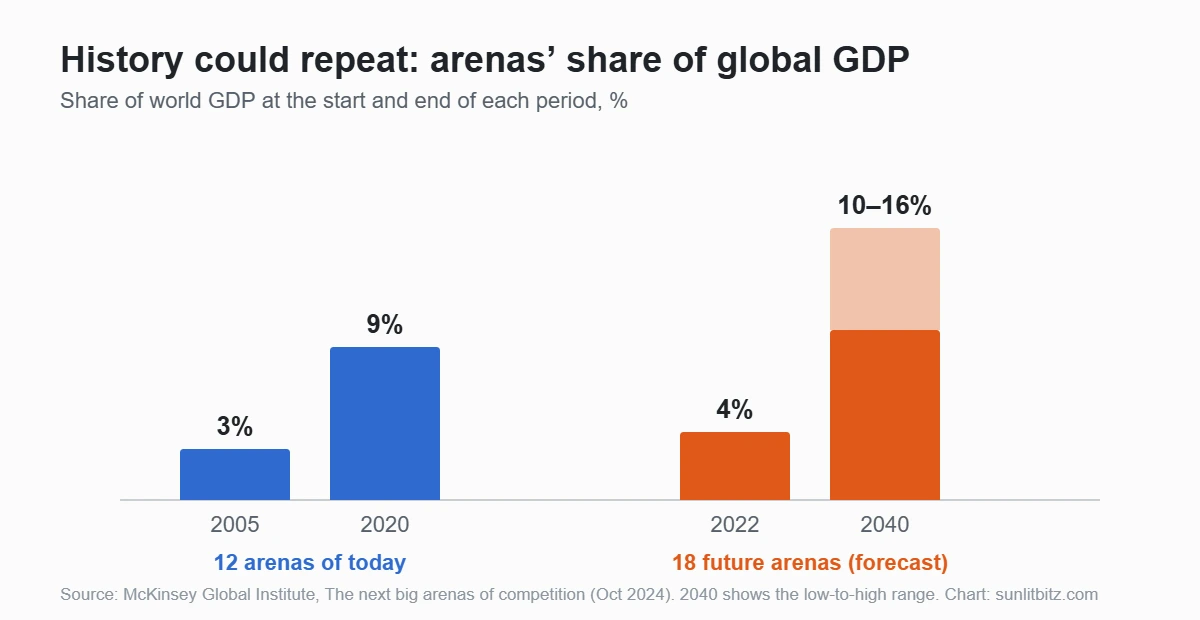
McKinsey says 18 industries could earn $29 trillion to $48 trillion in revenue by 2040, up from about $7 trillion in 2022. They could grow from about 4% of global GDP to 10–16%.
The fastest-growing one is AI software and services, which could grow 17–25% a year. That is why the next big arenas of competition matter even if you just run a blog about AI tools.
What is an “arena of competition”?
An arena is an industry with two traits at the same time:
- High growth: it takes a much bigger slice of the economy's growth than other industries.
- High dynamism: market share changes hands fast, so new players can beat old leaders.
Think of cloud services or electric vehicles after 2005. A few companies invested huge sums, the market exploded, and the ranking of winners kept changing.
Why arenas matter: today's arenas in numbers
McKinsey first looked back at 12 arenas of today from 2005 to 2020, such as software, e-commerce, cloud services and electric vehicles. The gap with other industries is big:
| 2005 to 2020 | 12 arenas | Other industries |
|---|---|---|
| Revenue growth per year | 10% | 4% |
| Market value growth per year | 16% | 6% |
| Share of global GDP | 3% → 9% | — |
| Share of economic profit | 9% (2005) → about 50% (2019) | — |
Quick Stat: In 2005, only one of the world's ten most valuable companies was in a future arena. By 2020, eight of the ten were.
The 3 ingredients that create an arena
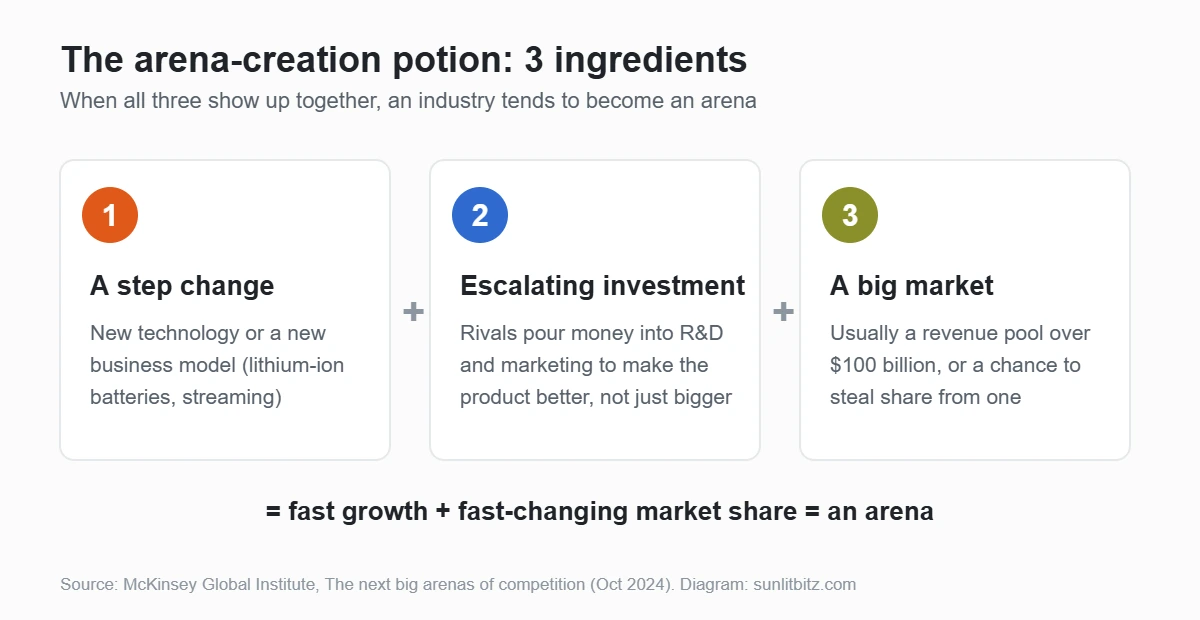
McKinsey calls it the arena-creation potion. When all three ingredients show up together, an industry tends to explode:
- A step change: a new technology or business model, like lithium-ion batteries for EVs or streaming for TV.
- Escalating investment: companies spend on R&D and marketing to make the product better, not just to make more of it, so rivals must spend too.
- A big or fast-growing market: usually a revenue pool of over $100 billion, or a chance to steal share from one.
The 18 next big arenas of competition
McKinsey splits the 18 future arenas of competition into three groups. The numbers show estimated revenue in 2040.
| Group | Arena | 2040 revenue (estimate) |
|---|---|---|
| Continuing | E-commerce | $14–20 trillion |
| Continuing | Electric vehicles | $2.5–3.2 trillion |
| Continuing | Cloud services | $1.6–3.4 trillion |
| Continuing | Semiconductors | $1.7–2.4 trillion |
| Spin-off | AI software and services | $1.5–4.6 trillion |
| Spin-off | Digital ads | $2.1–2.9 trillion |
| Spin-off | Streaming video | $510 billion–$1 trillion |
| Emergent | Shared autonomous vehicles | $610 billion–$2.3 trillion |
| Emergent | Space | $960 billion–$1.6 trillion |
| Emergent | Cybersecurity | $590 billion–$1.2 trillion |
| Emergent | Batteries | $810 billion–$1.1 trillion |
| Emergent | Modular construction | $540 billion–$1.1 trillion |
| Emergent | Video games | $550–910 billion |
| Emergent | Robotics | $190–910 billion |
| Emergent | Industrial and consumer biotech | $340–900 billion |
| Emergent | Future air mobility | $75–340 billion |
| Emergent | Drugs for obesity | $120–280 billion |
| Emergent | Nuclear fission power plants | $65–150 billion |
Which of the next big arenas of competition will grow fastest?
E-commerce stays the biggest by far. But size is not speed. If you rank the arenas by yearly growth, AI and robotics lead the race:
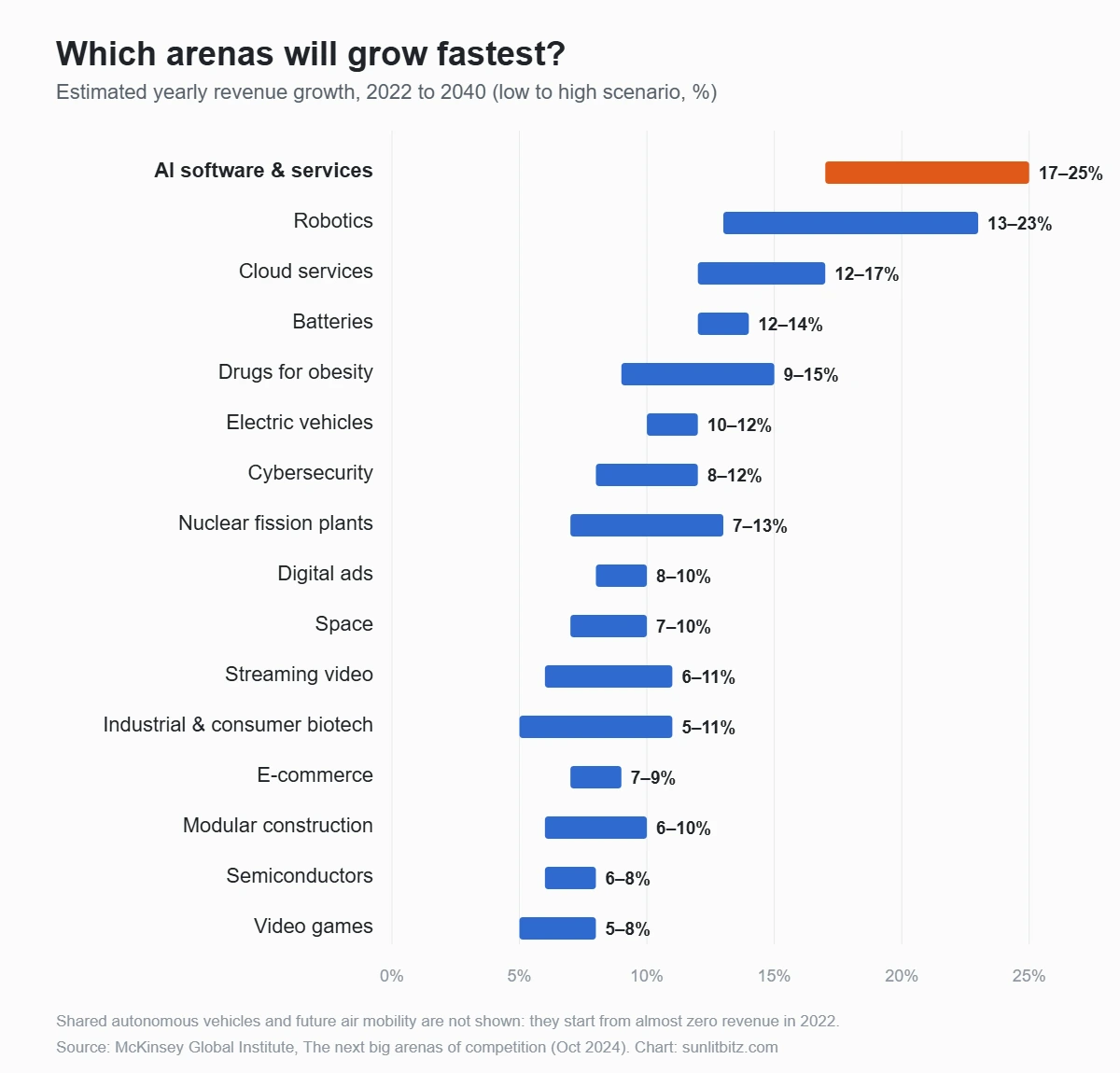
Key Takeaway: AI software and services starts small (about $85 billion in 2022) but could grow 17–25% a year, faster than any other arena McKinsey measured.
What changed by 2026?
In its 2026 follow-up (March 2026), McKinsey says the race has sped up. From 2022 to 2025, the next big arenas of competition pulled even further ahead:
- Faster growth: the 18 arenas grew revenue about 11% a year, versus 1% for other industries.
- AI leads: semiconductors, cloud and AI software added about $11 trillion in market value.
- US and China dominate: companies based there hold about 90% of the arenas' market value.
- New giants: nine companies now compete across several arenas at once.
What this means for bloggers and creators
You don't need to build rockets to benefit from the next big arenas of competition. Readers search for help with the tools these industries ship.
- Pick a growing niche: AI tools, cybersecurity, video games and streaming all create search demand every month.
- Follow the money: fast-growing arenas tend to have new products and affiliate programs.
- Write early: in a dynamic arena, the tools people use keep changing, so fresh reviews and comparisons win traffic.
The next big arenas of competition: questions people ask
What are the 18 arenas of competition?
They are e-commerce, AI software and services, cloud services, electric vehicles, digital ads, semiconductors, shared autonomous vehicles, space, cybersecurity, batteries, modular construction, streaming video, video games, robotics, industrial and consumer biotech, future air mobility, drugs for obesity, and nuclear fission power plants.
Which industries could lose arena status?
McKinsey names five arenas of today that may slow down: biopharmaceuticals, consumer electronics, information-enabled business services, industrial electronics and payments.
What could change the forecast?
The report lists three swing factors: geopolitics and technology rules, how fast AI spreads across industries, and the pace of the green transition.
Who wrote the report?
The McKinsey Global Institute published it in October 2024. The lead authors are Chris Bradley, Michael Chui, Kevin Russell, Kweilin Ellingrud, Michael Birshan and Suhayl Chettih.
Read the full report
This summary covers the big picture. For each arena's full profile, read McKinsey's report The next big arenas of competition and the 2026 follow-up. Then see which AI tools are worth your time in our guide to AI writing tools for bloggers.